The half double crochet stitch is a useful basic stitch that creates a fabric with moderate height, a soft texture, and a little more drape than single crochet. It is taller than single crochet but shorter than double crochet, making it a versatile choice for blankets, scarves, hats, garments, and many other crochet projects.
In this beginner-friendly tutorial, you will learn how to make a half double crochet stitch from the foundation chain, work your first row, turn your work, and keep your stitch count consistent. With a little practice, you will be ready to use this stitch in larger projects.
1. Materials and Tools
You only need a few basic supplies to get started:
- Smooth, medium-weight yarn: Choose a light color so you can easily see the individual stitches.
- Crochet hook: Check the yarn label for a recommended hook size. A hook around 5 mm is a common starting point for medium-weight yarn.
- Scissors: For cutting the yarn when your practice swatch is complete.
- Yarn needle: For weaving in loose ends.
Avoid very fuzzy or dark yarn when learning a new stitch. Smooth, light-colored yarn makes it easier to identify the foundation chain, the top loops of each stitch, and the spaces where your hook needs to go.
2. US Crochet Terminology and Abbreviations
This tutorial uses US crochet terminology. The US half double crochet stitch is called a half treble crochet in UK terminology, so check the terminology used in a pattern before you begin.
- hdc: Half double crochet
- ch: Chain
- st: Stitch
- sts: Stitches
- yo: Yarn over
- rep: Repeat
- RS: Right side of the fabric
- WS: Wrong side of the fabric
Two terms are especially useful for beginners:
- Working yarn: The strand that leads to your ball or skein of yarn.
- Yarn tail: The short loose end left when you begin or finish your work.
3. How to Hold the Hook and Yarn
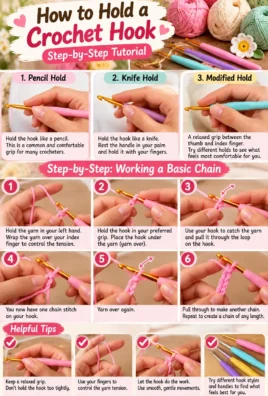
There is no single correct way to hold a crochet hook. Choose the position that feels comfortable and allows your hand to move naturally.
Pencil hold
Hold the hook much like a pencil, with your thumb and index finger near the thumb rest. This position can feel familiar if you are used to writing with a pencil.
Knife hold
Hold the hook much like a table knife, with your hand resting over the hook. Some crocheters find this position gives them better control.
Guide the yarn
Pass the working yarn through the fingers of your non-hook hand. Your fingers should guide the yarn without gripping it tightly.
The yarn needs enough tension to form neat stitches, but it must still slide freely. If you pull too hard, the stitches become difficult to work into. If the yarn is too loose, your stitches may vary in size.
Try both hook holds and adjust how you guide the yarn until the movement feels smooth and comfortable.
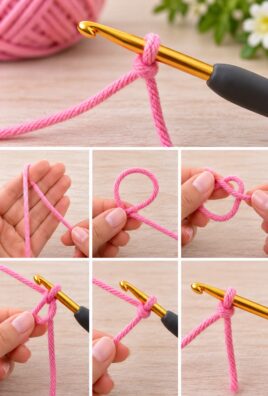
4. How to Make a Slip Knot
The slip knot creates the starting loop for your crochet work. It is not counted as a crochet stitch.
- Leave a yarn tail approximately 6 inches long.
- Make a loop with the working yarn crossing over the tail.
- Reach through the loop and pull a small section of the working yarn through it.
- Place the new loop on your crochet hook.
- Gently pull the yarn tail to tighten the knot around the hook.
- Adjust the loop so it slides comfortably along the hook without slipping off.
The loop should not be so tight that you cannot move the hook, and it should not be so loose that it falls off easily.
5. How to Make a Foundation Chain
The foundation chain creates the base into which you will work your first row of half double crochet stitches.
Step-by-step foundation chain
- Make a slip knot and place the loop on your hook.
- Hold the working yarn comfortably in your non-hook hand.
- Bring the working yarn over the hook from back to front. This movement is called a yarn over.
- Use the hook to catch the yarn and pull it through the loop already on the hook.
- You have made one chain stitch.
- Repeat the yarn over and pull-through movement until you have the number of chain stitches you need.
Practice with 16 chains
For your first practice swatch, make a foundation chain of 16 chains.
To count your chains, look for the small V-shaped links along the chain. Count each completed link, beginning with the one nearest the hook. Do not count the loop currently sitting on your hook as a chain stitch.
Keep your chain relaxed. If it is too tight, inserting the hook into the chains during the first row can be difficult. If your chain is very loose, the bottom edge may look uneven.
6. Step-by-Step: How to Crochet a Half Double Crochet Stitch
A half double crochet begins with a yarn over before the hook enters the target chain or stitch. You then pull up a loop, leaving three loops on the hook, and pull the yarn through all three loops at once.
Follow these steps carefully for your first stitch.
Step 1: Yarn over before inserting the hook
With your foundation chain on the hook, bring the working yarn over the hook from back to front.
You should now have the original loop and the new strand of yarn positioned on your hook. Keep the yarn in place as you move to the next step.
Step 2: Insert the hook
Count the chains from the hook. Remember that the loop on your hook does not count as a chain stitch.
For this practice swatch, skip the first two chains nearest the hook. Insert the hook into the third chain from the hook.
Push the hook under the top loops of that chain, keeping the yarn over on the hook.
Step 3: Yarn over again
Bring the working yarn over the hook once more, catching it with the hook.
You have now wrapped the yarn around the hook after inserting it into the chain.
Step 4: Pull up a loop
Carefully draw the hook back through the chain, bringing the newly caught yarn with it.
You should now have three loops on your hook:
- The original loop.
- The loop created by the first yarn over and insertion.
- The loop you have just pulled through the chain.
Pause for a moment and check the loops before continuing.
Step 5: Yarn over one more time
Bring the working yarn over the hook again. Make sure the hook catches the yarn securely.
This is the final yarn over before completing the stitch.
Step 6: Pull through all three loops
Draw the yarn over through all three loops on your hook in one continuous movement. You may need to tilt the hook slightly to help the yarn pass through smoothly.
When the yarn has passed through all three loops, one loop remains on the hook. Your half double crochet stitch is complete.
Do not stop after pulling through only two loops. A half double crochet is completed when the final yarn over passes through all three loops together.
Step 7: Work the next stitch
Move to the next chain in your foundation chain and repeat the same sequence:
- Yarn over.
- Insert the hook into the chain.
- Yarn over again.
- Pull up a loop to make three loops on the hook.
- Yarn over once more.
- Pull through all three loops.
Continue along the foundation chain, keeping the height of your loops and your yarn tension as consistent as possible.
7. Practice Your First Row
Now that you know how to make the stitch, work a complete practice row.
- Make a foundation chain of 16 chains.
- Yarn over.
- Skip the first two chains nearest the hook.
- Insert the hook into the third chain from the hook.
- Complete one half double crochet using the six movements described above.
- Work one half double crochet into each remaining chain across.
- Count your completed stitches when you reach the end.
You should have 14 half double crochet stitches in the first row. You started with 16 chains and skipped the first two chains to establish the height of the first row, leaving 14 chains for stitches.
Look at the top of your row. Each completed stitch should have a small V-shaped top, and one loop should remain on your hook, ready for the next step.
If your count is different, check whether you missed a chain or accidentally worked twice into the same chain. It is easier to correct the mistake now than after several rows.
8. Turn and Crochet the Second Row
Once you reach the end of the first row, you need to turn your work so you can crochet back across the stitches.
For this tutorial, the two turning chains do not count as a stitch. The first half double crochet of each new row is worked into the first stitch of the previous row.
Step-by-step instructions
- At the end of Row 1, make 2 chains.
- Turn your work so the opposite side of the row faces you.
- Look at the top edge of the previous row. Each half double crochet has two top loops that form a small V.
- Identify the first stitch of the previous row, immediately beside the turning chains.
- Yarn over and insert the hook under both top loops of that first stitch.
- Complete a half double crochet by yarning over, pulling up a loop, yarning over again, and pulling through all three loops.
- Work one half double crochet into each remaining stitch across the row.
- Be sure to work into the final stitch at the far edge. It can be easy to overlook this stitch because it sits close to the edge of the fabric.
You should have 14 half double crochet stitches in Row 2, just as you did in Row 1.
Continue the practice swatch
- Row 3: Ch 2, turn, hdc in the first stitch and in each remaining stitch across. You should have 14 hdc.
- Rows 4–8: Repeat Row 3, keeping 14 hdc in every row.
Count your stitches at the end of each row. If you consistently have 14 stitches, your edges should remain fairly straight.
9. How to Recognize a Half Double Crochet Stitch
Recognizing individual stitches makes it easier to work into the correct place on the next row.
The top of the stitch
Look along the top edge of your work. Each completed half double crochet has two loops that form a small V. These are the loops you usually work under when making the next row.
The loop on your hook
The loop currently on your hook is your working loop. It is not a completed stitch and should not be counted when checking the row.
A foundation-chain stitch
A foundation-chain stitch looks like a small V-shaped link in the starting chain. When working the first row, insert the hook into the specified chain rather than into the working loop on the hook.
A turning chain
The two turning chains raise your hook to the height needed for the next row. In this tutorial, they do not count as a half double crochet stitch.
The first and last stitches
The first stitch is beside the turning chain at the beginning of the row. The last stitch is at the opposite edge. Both must be worked into to maintain a consistent stitch count.
Tip: If you are unsure where the first or last stitch is, place a stitch marker in each edge stitch. Move the markers up as you complete each row.
10. Stitch Height and Tension
The half double crochet sits between single crochet and double crochet in height.
- Single crochet: Shorter stitches create a compact fabric.
- Half double crochet: Medium-height stitches create a balanced texture with a little more drape.
- Double crochet: Taller stitches create a more open fabric that often grows in height more quickly.
The half double crochet also has a distinctive horizontal strand or bar that may be visible across the front of the stitch, depending on the angle you view it from. This is a normal part of its structure.
How to maintain even tension
- Keep the working yarn moving freely through your fingers.
- Avoid pulling the loop too tightly against the hook.
- Try to draw each loop up to a similar height before completing the stitch.
- Use the same hook and yarn throughout your practice swatch.
- Pause occasionally to check that the edges and stitch sizes look consistent.
Your first swatch may have uneven stitches or slightly wavy edges. That is normal when learning a new stitch. With practice, your hands will become more familiar with the movements.
11. Common Mistakes and How to Fix Them
| Problem | Likely cause | How to fix it |
|---|---|---|
| Forgetting the initial yarn over | Starting the stitch like a single crochet | Remember to yarn over before inserting the hook into the chain or stitch. |
| Inserting the hook into the wrong chain | Miscounting from the hook | Remember that the working loop is not a chain. Skip two chains and insert into the third for the first row. |
| Having the wrong number of loops on the hook | Missing a yarn over or pulling up a loop incorrectly | Before the final pull-through, check that you have three loops on the hook. |
| Pulling through only two loops | Stopping before the stitch is complete | Yarn over and pull through all three loops in one continuous movement. |
| Making stitches too tight | Pulling the working yarn too firmly | Relax your grip and keep the loops at a comfortable height on the hook. |
| Making stitches too loose | Allowing the loops to become excessively large | Maintain gentle, consistent tension and avoid pulling up extra-long loops. |
| Skipping the first stitch of a row | Mistaking the turning chain for the first stitch | Remember that the turning chain does not count. Work the first hdc into the first stitch of the previous row. |
| Missing the last stitch | Overlooking the edge stitch | Count the V-shaped tops and use a stitch marker to identify the final stitch. |
| Adding an extra stitch at the edge | Accidentally working into the turning chain | Do not work into the turning chain for this pattern. Work only into the actual stitches. |
| Creating uneven row heights | Changing loop height or yarn tension | Draw loops to a similar height and keep your tension steady. |
| Losing the intended stitch count | Missing or adding stitches | Count at the end of each row and correct mistakes before continuing. |
12. How to Fasten Off
When your practice swatch is complete, secure the yarn so the stitches do not unravel.
- Cut the working yarn, leaving a tail approximately 6 inches long.
- Pull the cut end through the loop remaining on your hook.
- Remove the hook and gently pull the tail to tighten the loop.
- Thread the tail through a yarn needle.
- Weave the tail through several stitches on the wrong side of the fabric.
- If you have a starting yarn tail, weave that end in as well.
Fastening off is different from making a slip stitch. A slip stitch is a crochet stitch made by pulling yarn through a stitch and the loop on the hook. Fastening off secures the working yarn when you finish crocheting.
13. Practice Exercises
A little repetition will help you recognize the stitch and develop consistent tension.
Exercise 1: Practice the foundation chain
Make three foundation chains of 10, 16, and 20 chains. Focus on keeping the chain links even and loose enough for the hook to enter easily.
Exercise 2: Crochet a small swatch
Make a foundation chain of 16 chains and work eight rows of half double crochet. Aim for 14 stitches in every row.
Exercise 3: Count your stitches
Count the stitches at the end of every row. If the count changes unexpectedly, look for a missed edge stitch or an accidental extra stitch.
Exercise 4: Compare your tension
Look at the height and width of your stitches. If some stitches are much taller or tighter than others, slow down and focus on drawing each loop to a similar height.
Exercise 5: Undo and try again
If you make a mistake, gently pull the working yarn to undo the stitches until you reach the problem area. Rework the stitches carefully, checking the placement of your hook.
Repeated practice helps your hands remember the sequence, making it easier to use half double crochet in larger projects.
14. Frequently Asked Questions
What is a half double crochet stitch?
It is a basic US crochet stitch made by yarning over, inserting the hook, pulling up a loop, then yarning over and pulling through all three loops on the hook. It creates a medium-height stitch.
Is half double crochet suitable for beginners?
Yes. Once you understand the foundation chain and basic yarn-over movement, half double crochet is a useful stitch to practice. The most important step is learning to complete the final pull-through correctly.
How many loops should be on the hook before the final pull-through?
You should have three loops on the hook immediately before the final yarn over is pulled through all three.
How many turning chains are used in this tutorial?
Use two turning chains at the beginning of each row after the first row.
Do the turning chains count as stitches?
No. In this tutorial, the two turning chains do not count as a stitch. Work the first half double crochet into the first stitch of the previous row.
Why does my half double crochet fabric look uneven?
Uneven tension, inconsistent loop height, or missed stitches can cause an irregular appearance. Try working more slowly, checking your stitch count, and maintaining a relaxed grip on the yarn.
What is the difference between half double crochet and double crochet?
Half double crochet uses a yarn over before inserting the hook, but the final yarn over is pulled through all three loops at once. Double crochet has an additional step and is taller.
Why does the stitch have a horizontal bar?
The horizontal strand is a normal part of the half double crochet stitch structure. Its visibility depends on the yarn, tension, and angle from which you view the fabric.
How do I keep the edges straight?
Use the same stitch count in every row, work the first stitch beside the turning chain, and remember to crochet into the final stitch at the far edge. Stitch markers can help you identify the edge stitches.
15. Quick Reference
Materials
- Smooth, medium-weight yarn
- Crochet hook suitable for the yarn
- Scissors
- Yarn needle
Abbreviations
- hdc: Half double crochet
- ch: Chain
- st or sts: Stitch or stitches
- yo: Yarn over
- rep: Repeat
- RS: Right side
- WS: Wrong side
Half double crochet sequence
- Yarn over.
- Insert the hook into the chain or stitch.
- Yarn over again.
- Pull up a loop, leaving three loops on the hook.
- Yarn over once more.
- Pull through all three loops, leaving one loop on the hook.
First row
- Make 16 chains.
- Skip the first two chains nearest the hook.
- Work the first hdc into the third chain from the hook.
- Work hdc into each remaining chain.
- Expected count: 14 hdc.
Following rows
- Ch 2 and turn.
- The turning chains do not count as stitches.
- Work hdc into the first stitch and each stitch across, including the last stitch.
- Keep 14 hdc in each row of the practice swatch.
Finishing
– Cut the yarn, pull the tail through the final loop, tighten gently, and weave in the ends with a yarn needle.
Conclusion
The half double crochet stitch is a versatile technique that can help you build confidence and create a wide range of crochet projects. Once you become comfortable with the yarn-over movement and the final pull-through, you will find it easier to work consistent rows and recognize each stitch.
Start with a small practice swatch, count your stitches carefully, and give yourself time to develop an even rhythm. With practice, you will be ready to use half double crochet in blankets, scarves, hats, garments, and many other handmade creations.
Leave a Comment